Thursday, 20 June 2013

EAST MIDLANDS BOAT TRIP 3 June 2013

Dave Parky writes:-


I couldn’t understand it- there  I was listening to the Shipping Forecast-‘ Dogger, Fisher, German Bight’and  we were about to embark on the open seaways of the River Trent with no mention.  Did they not realise that we were about to upgrade from the  trickling tributries and canals to one of   the Nations major rivers!  No matter,  on arrival at Thornhill country (Gunthorpe), we were met by the reassuring presence of Mr & Mrs McCommodore who  briefed  that no longer would we boys need to disembark at every lock to open and close, but that in the big boys club the locks were ’automatic’.
What would there  be for us to do? No longer the worry of the £10 lost  deposit should we accidentally drop the  lock  keys into the water.  Would we ever be able to regain the lost skills – honed to a fine art over many years of experience?  Would it be like having a dish washer and never revert to washing up- or sliced bread never going back to the tin , or diposable nappies and – forget it!  All we had to know was on arrival at each lock, we were to tie up, fore and aft, to a pole  recessed in the lock wall and hold the rope light. On arrival these looked like flimsy plastic rods and about as much use as a paper clip, but on closer inspection these revealed an inner steel wire, enough to hold fast the largest of ‘Cutters’.  


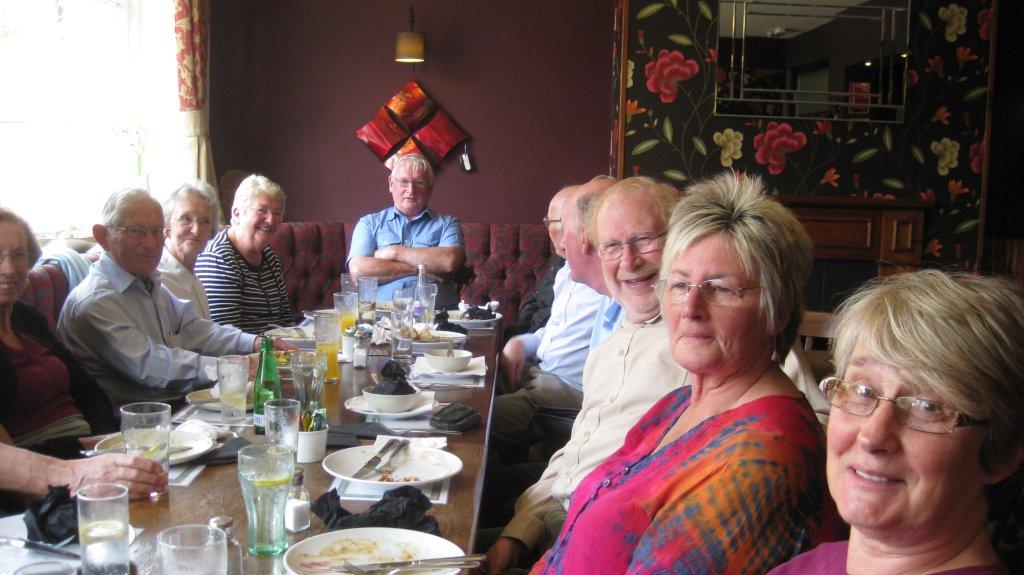
And so  2 vessels, with 12 souls on each, set sail for 3 hours in a north easterly direction towards Fardon for lunch. Conditions bright sunshine with a light to moderate north easterly breeze.  Lunch had been pre- ordered so that we wouldn’t be hanging around ,however, hose on one course had to wait for those on 2 or 3 to finish their starters before getting the mains- not to mention those who  had ordered sweets ...........This meant that time being of the essence we left late-  tension was palpable- would we get back to the last lock intime before it closed?  Would we get to the boat yard in time to avoid excess charge or  ongoing appointments missed? We needn’t have worried, Mr McCommodore had phoned ahead to alert the lock keeper of our delay- the curse of the creme brulee had been exorcised!  As it happened the lock keeper had tried to phone back that there would be a delay anyway owing  to a north bound vessel due in the lock at the same time. Depending on the depth of the water,the lock gates seemed massive and on opening and closing it seemed like being in the bowels of Colditz!The return journey was extemely peaceful, albeit a certain pace had to be kept.  Mr & Mrs McCommodore would surrepticiously have a hand on the swingometer lest us ‘old salts’ and the excitable novices get carried away whilst encountering hazzards.
 Much bird life was to be  seen and the Chief Ornithologist on board was widely consulted, only to find he’d nodded off. He was joined by several of the bretheren-  was it the calm waters or age- or both! A survey had been recently undertaken regarding the swans along the Trent Valley and apparently only 10% were breeding. The reasons for this are unknown but it is thought the swans  have a sixth sense and can detect ‘austerity!’. So where did the Trent differ from say the Soar.  Well there were no tow paths, however there  is a footpath which more or less runs from Attenborough, Nottingham for 90 miles to Grimsby. Also at no point could we  / did we touch the sides!  Another very enjoyable adventure with the usual thanks  to the Mcs. See photos on website. (Oh  for the old days of pictures and drawings!) 

The photos show the sunny day, which the Lady crew enjoyed!!!!!!!!!!!!!!!!!Smiles galore !!!!


Tuesday, 13 November 2012

Christmas Lunch.

The Christmas Lunch was again organised by Richard Horler at the Rancliffe Arms, Bunny. Splendid meal and an attendance of some 47 .The pictures tell it all.

Richard on Reception Duties 


 The ladies enjoying pre-dinner drinks

 The gents enjoying a pre lunch pint.

 The drinks have kicked in and it's all smiles.


For 2013 December may be targetted if  the same kind of price can be obtained. November is uually cheaper!!! Thanks Richard.
The RMS Members expressed their thanks for the RMS support.

Friday, 5 October 2012

Thorntons Visit


September – Visit to Thorntons arranged by Mike / Maggie Nicholass

     
Maggie Nicholass writes:-.


On 20th September a party of 16 from EM CERRSA group visited the Thornton's Chocolate Factory in Somercotes, Derbys - a very impressive modern site. Meeting in Reception (where the first invitation to try the Continental selection was taken up), there was no Willy Wonka to greet us, but guides Damian and Paul were fine substitutes. An introductory video was followed by a tour of the factory and warehouse. This proved to be a most interesting and enlightening couple of hours. Although much  machinery was in evidence (all made in Germany sorry to say) the manufacturing processes are labour intensive with many hundreds of people  employed at Thornton's.  Two of our party joined the production line and tried their hand , with some success, at "crimping" - a highly skilled process finishing the continental range truffles. (Mel has, in fact, been taken on and starts on the early shift next week). The tour then moved on to a visit to the samples bar where all the current production flavours were available to taste( this being a selection of the rejects). A visit to the coffee bar and inevitable shop concluded the tour where the very favourable prices enabled all to purchase to their heart's content. We were presented with Goodie Bags by our tour guides who were then thanked for their interesting and lively presentations. Finally a suitable donation was made to the NSPCC -  Thornton's chosen charitable cause.
 
Lunch was taken at the nearby Ashwood Inn - a good value, tasty carvery from where the party dispersed. A good day out! 
Tour photographs on the web site courtesy of Irene Chapman to whom many thanks.”
 
If you click the photos they enlarge and close with an "X" in the top right corner.


Sunday, 11 December 2011

DECMBER 2011 TRIP TO LILLE

Dave Parkinsontheparkys@mypostoffice.co.uk ) Writes:-                 
"22 members and 5 guests travelled via EUROSTAR to Lille France for a 5 day  break.
We stayed at a small but friendly hotel very convenient for the EUROSTAR and opposite the Gare Flandres- which provided immediate access to more ‘local’ travel in addition to the Lille Metro.
As usual on arrival we all gathered for evening meal which is not always easy for a group of 27, particularly on a Monday night in France when it is usual for restaurants to close, however, our hotel arranged with  our travelling interpreter, Allan Lloyd,  the Lille Casino. They  provided a very comprehensive buffet, very agreeable wine and all significantly discounted. ( Don’t tell Sarkozy!!)
Lille is  quite a large City but fairly compact with museums, art galleries, and substantial architectural magnificance.  During our stay, of course there was the usual Christmas market and the focal point of a big wheel.  Plenty of atmosphere!
Trips by various members to places like Arras, Bruges, Brussels,  Ghent, Ypres. The weather was fairly kind to us,  dry-ish daytimes but with a high wind chill factor!


Our trips operate on the basis  that  people do their own thing until the last evening when we all gather for the ‘last supper’.  No feet washing – although a  few hot bowls of water would have provided much comfort after 4 days on the hoof!!  Tempting as it was to return to the casino- it was felt something less clinical and more traditional would suit and after trialling a few places we selected a restaurant just off the main square by ‘the wheel’ which provided  a good selection of food at a good price-( and they could accommodate 27 virtually in our own room).  Late comers ‘mission control’ ( Carole G and Brenda) arrived suitably flushed after directions were lost in translation from Flemish to French to English.  Good job Channel 4  News did not broadcast their  interview with Jon Snow (in Brussels for the EU summit) giving their views on the Euro.  (Too soon before the bike shed!) Finally, Monsieur Le President ( Mike Patten- not the aforementioned)  gave a toast to absent friends Brother Ralph,  John Bartley, and Brian Mc.and their ladies- wishing speedy recoveries where appropriate.  "  Photos from Dave tell it all!                                                          

Saturday, 26 November 2011

Christmas Lunch 25th November 2011

Thanks Richard  Horler (alias Dick)for the organisation and to the Rancliffe Arms for a splendid carvery meal and table service for starters sweets and coffee. Thanks to the RMS for support for its members.

Sunday, 16 October 2011

East Midlands October visit

Ian Godson Ian Godson [godson@ntlworld.com] writes:-
Fifteen intrepid members of the East Midlands branch of CERSA, with their enquiring minds, visited Rotherham’s Magna Science Adventure Centre on 11 October.
Before plunging into the Stygian darkness of the defunct Templeborough steelworks, our guide Bob, who had spent his working life selling special steels, (e.g. for spark plugs to the  world’s automotive industry) gave us a brief history of steel making on the site. Needless to say, once on our tour, he blinded us with science.
Would you believe that iron making started with the Romans on that very site? The steel works was built over the Roman fort near Dead Man's Hollow. After the Romans went home to Italy, there was a break of 800 years before it re-started. The present steel works was  built in 1917, is 160 feet high, and a third of a mile long. It was originally set up by two Sheffield bookies, Steel & Peech – wonder how they came by their money to invest?
Templeborough Steelworks
The history of steel and iron-making was explained in terms that meant we understood most of it, but the statistics were incredible. Steel, Peech and Tozer's massive Templeborough steelworks  was, at its peak, over a mile long, employing 10,000 workers, and housing six electric arc furnaces producing 1.8 million tonnes of steel a year. The company became a major force in the production of steel in Britain. The plant was greatly expanded with cogging mills, rail mills and plants for the manufacture of steel springs and railway axles.  In earlier days, the Bessemer converters were replaced by three open hearth furnaces by 1897. The existing building, built in 1917, was modified in the 1960's and became in the 1970's, the largest foundry in Europe. The electricity used by the six electric arc furnaces would have supported a town the size of Rochdale. It closed in 1993. The history of the Templeborough Steelworks can be found at Steel Town - Steel, Peech and Tozer - Templeborough Steel Works.
The Transformation
The design of the new Magna makes full use of two massive 350 metres long, 35 metres tall bays that form the main cathedral-like shed, the interior of which is an awe-inspiring space with a scale only hinted at by the exterior. Pin holes in the cladding allow shafts of light to penetrate deep in to the dark interior. The enormous nine-storey high transverse aisles form a striking entrance to the attraction, whilst inside artefacts from the original steel making process have been retained as evocative sculptures from the past. Only the old scrap delivery bays, on the north side of the building, have been demolished. The main building has been retained, its steel structure displaying a patina of rust, heat and scorch marks, reminiscent of its past life. Within the building, the original artefacts sit amongst the individually themed pavilions: earth, air, fire and water, each incorporating spectacular special effects, using the latest technology, to explore the four elements and the basic components of the steelmaking process. Lightweight walkways and bridges connect the exhibits horizontally with minimum intervention, whilst vertical access is provided via the refurbished transformer building. The car park features the 'skeleton' of retained steel uprights of the crane rail supports and elements of the building's past, offering a dramatic three-dimensional backdrop to the sheer bulk of the main building. The new north elevation has been clad in profiled steel, matching the retained, black painted, cladding of the old building. The steelwork of the existing crane rails and hoppers is exposed.  The Big Melt, ( http://www.visitmagna.co.uk/content/59/the-big-melt) is undoubtedly one of Magna's most breathtaking features.  Heard and seen from almost every part of the building, the show is set around 'E' furnace, one of the original electric arc furnaces, unused since the days of Sheffield's booming steel industry.In a pyrotechnic and audio display powerful enough to shake everything underfoot and overhead, the steel making process is perfectly re-created (except for hundreds of tons of molten steel, and of course the melting temperatures!)
Templeborough Steel Works
The Templeborough Melting Shop, once described as 'the Anvil of South Yorkshire', was built during the early months of the First World War by Steel, Peech & Tozer to meet the demand for steel suitable for shells. It was the largest melting shop of its type in Europe. The structure was nine storeys high, with the main building formed of two 350m long bays containing 14 open hearth furnaces. Here scrap steel from many sources was melted down. Much of the steel needed in both world wars was produced here. World War Two saw steel production at Templeborough for shells, tanks and wheels increase to such an extent that it became a prime target for the Luftwaffe in the North of England. By the 1950s, Templeborough's open hearth furnaces were out of date and the United Steels Company, of which SPT had become a part in 1918, replaced them with electric arc furnaces. At its height in the 1950s, the plant employed more than 10,000 people as part of the SPT empire, which included Templeborough, Ickles and Brinsworth. SPEAR (Steel Peech Electric Arc Reorganization) introduced brand new technology and Templeborough thrived as the world's largest electric arc steel making plant providing steel for the railways and motor industry. The nationalisation of the steel industry in 1967 saw SPEAR become part of the British Steel Corporation's Rotherham Division. In the early 1980s, the plant enjoyed a brief revival when a continuous casting machine was introduced producing quality engineering steel, but the doors were finally closed in 1993.
After an amazing morning, lunch was taken, and then some of us visited the interactive pavilions - air, earth, fire & water - within the huge building. Mike & Pat Patten were found discussing how much water they each used in the course of a day. (It apparently depended on who washed up, how often, how many showers/baths each had, etc, etc.). I was able to achieve a lifelong, but minor ambition, by driving a JCB digger in the “Earth” pavilion.  All in all, a most interesting day, learning what put the Great in Great Britain! Thanks are due to Irene & Ralph Chapman, who provided some of the pictures and organised everything for us.

Wednesday, 29 June 2011

Canal Cruising with Commodore Mc Murray and his Vice.

Carol and Roger obviously had a word as the weather was suberb ... even down to the cooling "sprinkle" on the return leg. The trip was out from Stoke Golding to The Lime Kiln ? Inn for Lunch .. preordered as we past on our way to the turnaround. The pictures I hope give a flavour of another excellent "cruise"!
 Roger completes the paper work... lunch should be Ok!
Getting ready to board.


 Commodore and Dave Parky wave to the Vice-Commodore who is leading the way!

 Zig Zag Martin Arnold smiles at the tiller and passes safely under the bridge.

Below Roy Thornhill's securing the barge or is it his lace?


 Return trip and Vice Commodore gives way and drops in behind. Below some passengers shelter from the weather???
 
 The swans are undisturbed. What a good day. Thanks again C & V.C.